
Stage 4 Bedsores

- Reviewed By
Anthony C. Lanzone, Founding Partner
A stage 4 bedsore is a severe, full-thickness wound that exposes muscle, tendon, or bone. These injuries are preventable and often indicate nursing home neglect. If your loved one has developed a stage 4 pressure ulcer, you may be entitled to compensation.
Table of Contents:
- Stage 4 Bedsores Explained
- Stage 4 Bedsore Symptoms and Signs
- How Serious Are Stage 4 Pressure Sores?
- Causes of Stage 4 Bedsores
- Medical Treatment and Recovery Time for Stage 4 Pressure Ulcers
- How Long Can You Live with a Stage 4 Bedsore?
- Prevention
- Recovering Compensation for Stage 4 Pressure Ulcer Injuries
Stage 4 Bedsores Explained
A bedsore, also known as a pressure ulcer or pressure sore, occurs when pressure on a bony area restricts the blood flow to the area, causing the tissue to die. A stage 4 bedsore is a full-thickness wound that goes beyond the skin and into the muscles, tendons, and bones.
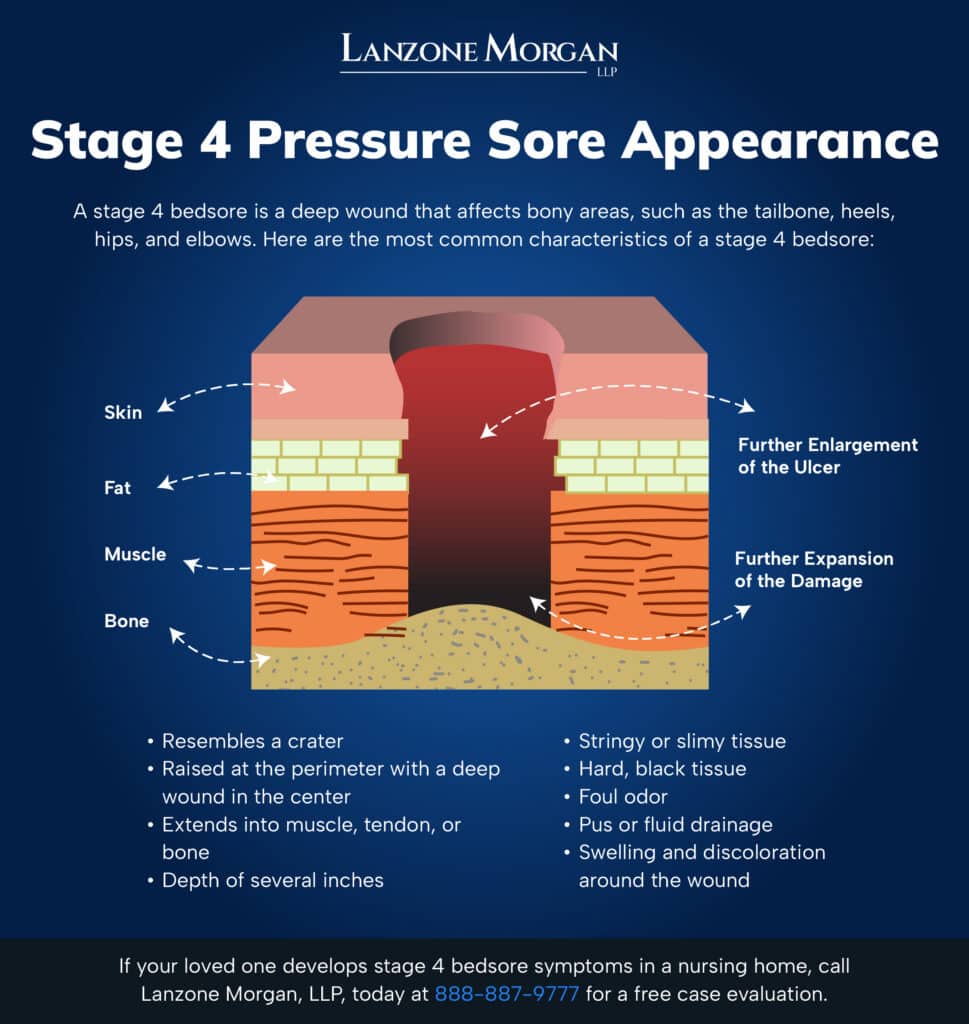
A stage 4 bedsore typically looks like a sinkhole, with a raised lip around the perimeter and a deeper wound in the middle. The raised area, called epibole, occurs when the edges of the top layers of the skin roll downward and inward instead of growing across the wound to close it. This prevents healing and can cause treatment to take months or years. Some stage 4 pressure wounds never heal.
A stage 4 bedsore is a serious nursing home injury that usually means the resident has gone without proper positioning and skin care for an extended period.
Stage 4 Bedsore Symptoms and Signs
Early diagnosis is crucial for effective treatment of bedsores. By the time it worsens to a stage 4 bedsore, significant damage has already occurred. Thus, it’s important to watch for the signs of a bedsore before it worsens to a stage 4 wound.
Most pressure sores show up in areas of the skin where bones are close to the surface, such as the heels, tailbone, hips, back of the head, ankles, and shoulder blades.
If you have never seen one before, you may be wondering what a stage 4 bedsore looks like. The following are some common stage 4 bed sore symptoms:
- Deep wound with a crater-like appearance
- Visible muscle, tendon, or bone
- Stringy or slimy dead tissue, called slough, which is usually yellow, tan, gray, green, or brown
- Hard or leathery tissue, known as eschar, often with a black appearance
- Foul odor from the wound
- Drainage or pus
- Warmth, swelling, or red discoloration in the surrounding skin
How Serious Are Stage 4 Pressure Sores?
Every year, approximately 24,000 people die of complications from bedsores, and stage 4 is the most deadly level. The severity may be worse than it seems. Sinus tracts often form. These are tunnels that extend from the surface wound into deeper body structures. Another common complication, undermining, occurs when a stage 4 bedsore widens under the outside edge, causing the wound to appear smaller than it actually is.
Stage 4 pressure sores expose internal structures to the outside world, creating a risk of life-threatening complications, including the following:
- Cellulitis: Bacterial infection of the skin
- Osteomyelitis: Bone infection
- Septic arthritis: Joint infection
- Necrotizing fasciitis: Flesh-eating disease
- Sepsis: Extreme response to infection, leading to organ failure and death
- Gangrene: Tissue death, potentially leading to amputation
- Protein wasting: Loss of up to 50 grams of protein daily from drainage
- Bacterial meningitis: Infection of the brain
- Endocarditis: Inflammation of the heart
- Chronic anemia: Iron deficiency
Causes of Stage 4 Bedsores
Stage 4 bedsores develop when prolonged pressure and repeated stress restrict blood flow to the skin and underlying tissues, causing the tissue to break down and die. Constant pressure on bony areas, such as the tailbone, hips, and heels, is the primary cause, and the damage is often exacerbated by moisture and shearing forces. Shearing occurs when the skin moves in one direction while the underlying tissue moves in another, such as when a resident slides down in a bed or chair, damaging blood vessels and accelerating tissue loss.
Certain residents face a higher risk of developing severe bedsores, including those with limited mobility, fragile or thinning skin, poor circulation, incontinence, or chronic medical conditions such as diabetes or vascular disease. Malnutrition and dehydration further weaken the skin and impair the body’s ability to heal. While these factors increase vulnerability, stage 4 bedsores typically develop over time as early skin breakdown goes unnoticed or unaddressed.
How Long Does It Take To Get a Stage 4 Bedsore?
The time it takes for a stage 4 bedsore to form can vary. Stage 4 pressure sores often develop gradually, over the course of weeks or months, but they can also develop rapidly. Stage 1 and 2 bedsores can develop within hours, and based on the cause of the breakdown and the resident’s health status, they could progress to stage 4 within days. Bedsores typically result from neglect, but allowing one to progress to stage 4 is particularly inexcusable.
If your loved one has developed a stage 4 bedsore, they may have a long road to recovery ahead, and it could be fatal. Our experienced California nursing home abuse lawyers can help you hold the nursing home accountable and recover substantial compensation for your loved one’s injuries.
Medical Treatment and Recovery Time for Stage 4 Pressure Ulcers
Many families wonder whether a stage 4 bedsore can heal and how long it takes, but the answer is complex. Stage 4 pressure wounds can sometimes heal, but the process can take months or years. According to research, approximately 30% of stage 4 pressure ulcers heal within six months, compared to 70% of stage 1 or 2 pressure sores. One study found that 41.7% of all bedsores heal after 1.8 years.
The time it takes to recover from a stage 4 bedsore depends on the resident’s overall health and comorbidities. Many nursing home residents with pressure sores have other conditions that complicate recovery, such as diabetes, peripheral vascular disease, or cancer.
How Are Stage 4 Bedsores Treated?
Once they occur, treatment for a stage 4 bedsore includes the following:
- Pressure relief through repositioning and pressure-relieving devices
- Wound cleaning and debridement, the removal of dead tissue, such as slough
- Antibiotics for serious infections
- Appropriate wound dressings
- Topical infection treatment, such as silver, honey, alginate, and negative pressure therapy
- Hydrogel, transparent film, and foam treatments for non-infected
- Skin grafts or reconstructive surgery to allow healthy skin to cover the wound
- Hydration and nutrition monitoring, and increased protein intake
Surgical treatments, such as skin grafts, are often unsuccessful for stage 4 bedsores. Pressure relief and wound care are critical. However, a nursing home that fails to prevent bed sores may not be trustworthy enough to treat them effectively.
How Long Can You Live with a Stage 4 Bedsore?
Stage 4 bedsores can significantly reduce life expectancy. One recent study found that older adults with pressure injuries have a 260% higher risk of death within 21 months compared to people without pressure injuries.
Since most people with stage 4 pressure ulcers have other health conditions, it is difficult to pinpoint how many of these deaths directly result from pressure ulcers. However, a 2003 study found that 68.9% of people with full-thickness pressure ulcers died within 180 days, with an average of 47 days from onset to death.
These statistics underscore the serious nature of these injuries and highlight the importance of proper nursing care in preventing such injuries.
Prevention
Prevention is the best treatment for stage 4 pressure ulcers. Bedsores in nursing homes can be prevented by simply meeting their legal, ethical, and moral obligations to provide the care each resident needs. Nursing homes can prevent bedsores by doing the following:
- Assess each resident’s risk upon admission and as needed, depending on each resident’s health status and risk factors
- Perform daily skin checks for residents at risk
- Reposition immobile residents at least every two hours
- Use pressure-reducing mattresses, mattress toppers, seat cushions, and pads
- Keep the skin clean and dry, and apply moisture barrier creams as needed
- Provide residents with well-balanced nutrition and hydration
- Encourage residents to participate in regular physical activity as they are able
Nursing homes that fail to provide these basic care measures contribute to the formation of bedsores and may be held liable through a bedsore lawsuit for the financial and emotional costs.
“Nursing homes have a duty to do everything in their power to prevent a resident from getting a pressure sore. Or, if the resident already has a pressure sore or bed sore when they enter the facility, the nursing home has a duty under federal law to do everything possible to prevent the worsening of that already existing pressure sore. Federal regulation states that, based on the comprehensive assessment of a resident, the facility must ensure that: Number one, a resident who enters the facility without a pressure sore does not develop a pressure sore unless the individual's clinical condition demonstrates that it is unavoidable. Number two, a resident having pressure sores receives necessary treatment and services to promote healing, prevent infection, and prevent new sores from developing. So, while not every pressure sore or bed sore is preventable, the nursing home has a legal duty to do everything in its power to prevent them from developing.”
- James Morgan, Founding Partner
Recovering Compensation for Stage 4 Pressure Ulcer Injuries
Nursing homes are responsible for providing quality care to prevent bedsores. You may be entitled to substantial compensation for the financial and emotional costs of a stage 4 bedsore, including medical expenses, lost wages, pain and suffering, and more.
We have 75+ years of experience with a proven track record of holding nursing homes accountable. We have recovered over $250 million in compensation, including the following bedsore settlements and verdicts:
- $4.5 million verdict for a wrongful death involving an infected bedsore
- $3 million settlement for a dependent adult who developed a coccyx bedsore
- $1.25 million settlement in the death of an assisted living facility resident who developed a bed sore
- $750,000 settlement for an elderly resident who developed a coccyx bedsore
We are here to help you pursue justice for your loved one’s stage 4 bedsore. Call 888-887-9777 or contact us online for a free case review.
VIEW SOURCES
Bedsores (Pressure injuries). (2025, November 18). Cleveland Clinic. https://my.clevelandclinic.org/health/diseases/17823-bedsores-pressure-injuries
Dale, B., Mackey, D., McNichol, L., Pierce, B., & Wound, Ostomy and Continence Nurses Society. (2019). WOUND, OSTOMY AND CONTINENCE NURSES SOCIETY’S GUIDANCE ON OASIS-D INTEGUMENTARY ITEMS. In Wound, Ostomy and Continence Nurses Society [Guidelines]. Wound, Ostomy and Continence Nurses Society. https://cdn.ymaws.com/member.wocn.org/resource/resmgr/document_library/oasis-d_best_practice_docume.pdf
Long-term outcomes of full-thickness pressure ulcers: healing and mortality. (2003, October 1). PubMed. https://pubmed.ncbi.nlm.nih.gov/14652420/
Raetz, J. G., & Wick, K. H. (2015, November 15). Common questions about pressure ulcers. AAFP. https://www.aafp.org/pubs/afp/issues/2015/1115/p888.html
Zaidi, S. R. H., & Sharma, S. (2024, January 3). Pressure ulcer. StatPearls – NCBI Bookshelf. https://www.ncbi.nlm.nih.gov/books/NBK553107/
- 356 Redondo Avenue, Long Beach, CA 90814
- 888-887-9777
- Fact-Checked
This content has been legally reviewed and approved by nursing home abuse attorney, Anthony Lanzone. Anthony holds notable memberships with professional organizations including the American Association for Justice and Consumer Attorneys of California.
VIEW SOURCES
Bedsores (Pressure injuries). (2025, November 18). Cleveland Clinic. https://my.clevelandclinic.org/health/diseases/17823-bedsores-pressure-injuries
Dale, B., Mackey, D., McNichol, L., Pierce, B., & Wound, Ostomy and Continence Nurses Society. (2019). WOUND, OSTOMY AND CONTINENCE NURSES SOCIETY’S GUIDANCE ON OASIS-D INTEGUMENTARY ITEMS. In Wound, Ostomy and Continence Nurses Society [Guidelines]. Wound, Ostomy and Continence Nurses Society. https://cdn.ymaws.com/member.wocn.org/resource/resmgr/document_library/oasis-d_best_practice_docume.pdf
Long-term outcomes of full-thickness pressure ulcers: healing and mortality. (2003, October 1). PubMed. https://pubmed.ncbi.nlm.nih.gov/14652420/
Raetz, J. G., & Wick, K. H. (2015, November 15). Common questions about pressure ulcers. AAFP. https://www.aafp.org/pubs/afp/issues/2015/1115/p888.html
Zaidi, S. R. H., & Sharma, S. (2024, January 3). Pressure ulcer. StatPearls – NCBI Bookshelf. https://www.ncbi.nlm.nih.gov/books/NBK553107/